Español
 English
 Français
 Deutsch
 Italiano
 Nederlands
 Português
 日本語
 中文
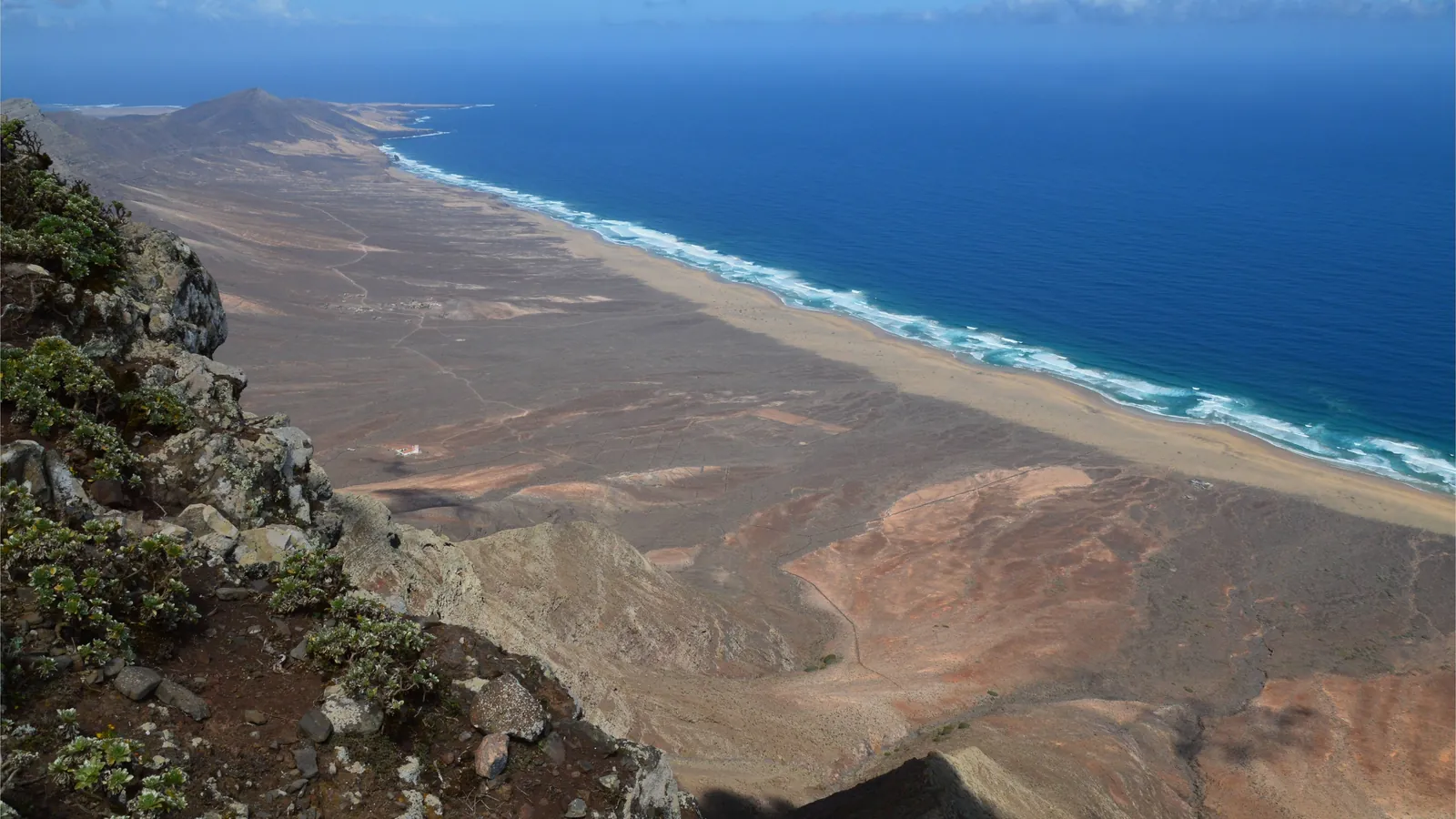
Fuerteventura is the second-largest Canary Island and the closest to the African coast, less than 100 km away. It stretches about 100 km from north to south, so where you arrive can have a big impact on your first few days. This guide covers how to get there by plane and boat, how to get around Fuerteventura and what changes depending on the time of year.
By plane
Fuerteventura Airport (FUE) is on the east coast, next to El Matorral, about 5 km south of Puerto del Rosario. It is the gateway for almost all travellers: according to Aena, it handled 6.9 million passengers in 2025, up 6.8% on the previous year—the biggest increase of any Canary Islands airport.
Its central location is an advantage. Caleta de Fuste is about 10 minutes away by car, Corralejo about 40 minutes, and Morro Jable, at the southern tip, just over an hour.
Flights from mainland Spain
The most frequent routes are from Madrid and Barcelona, which operate year-round. Airlines include Iberia Express, Air Europa, Vueling and Ryanair, with direct connections from other mainland cities added during peak season. The flight from Madrid takes about 2.5 hours; from Barcelona, a little longer.
Flights from other islands and Europe
Binter connects Fuerteventura with Gran Canaria and Tenerife North on flights of under an hour, which are useful if you’re island-hopping or making a connection. There is a wide range of international flights: Germany and the UK usually have the most scheduled seats after the domestic market, and winter is peak season for European visitors.
By boat
The ferry makes sense if you’re coming from another island or want to bring your car. From 30 June 2026, the Cádiz–Canary Islands route no longer calls at Puerto del Rosario, so there is no direct connection with mainland Spain. These are the routes to know about:
- Playa Blanca (Lanzarote) – Corralejo: the most popular route. Baleària, Fred. Olsen and Líneas Romero operate it, with more than 20 departures a day and crossings lasting 25 to 35 minutes.
- Las Palmas de Gran Canaria – Morro Jable: operated daily by Fred. Olsen and Baleària, taking about 2 hours on the fast ferries.
- Las Palmas de Gran Canaria – Puerto del Rosario: an overnight crossing of about 6 hours, mainly for travellers with a vehicle.
- From mainland Spain: the most direct route is the boat from Cádiz to Arrecife, which takes over a day, followed by the crossing from Playa Blanca to Corralejo.
In 2026, Baleària took over Armas Trasmediterránea’s routes in the Canary Islands. Both brands are operating during the transition, so you may see either name at the port or on your ticket. If you arrive via Lanzarote, combining the two islands in one trip is very easy.
Getting around the island
Hire car
This is the most convenient option. The two main roads, the FV-1 heading north and the FV-2 heading south, start in Puerto del Rosario and make it easy to explore the island. You’ll find car hire companies at the airport and in the main tourist centres. If you plan to drive to Cofete or other beaches via dirt tracks, check in advance whether your rental agreement covers those roads.
Bus
Intercity buses are run by Tiadhe under a concession from the Cabildo, with 18 routes. Route 3 connects Puerto del Rosario, the airport and Caleta de Fuste, and since June 2026 has also had an express service with electric buses. In the north, route 6 links Puerto del Rosario with Corralejo; in the south, routes 1 and 10 go to Morro Jable.
Between Costa Calma and Morro Jable, route 5 increased to 220 weekly departures following the 2026 service boost. You can pay the driver in cash or use the non-resident card, which can be bought on board and gives you a discount on the fare.
Taxi and bike
There are taxi ranks at the airport and in the main centres. Longer journeys, such as the trip south, can be expensive, so it’s worth asking the fare in advance. Road cycling is popular thanks to the good weather, but the wind is constant and some stretches are long, with no shade or services.
When to go and practical tips
Fuerteventura has a mild climate all year round, with little rain. Winter attracts European visitors, while July and August bring plenty of travellers from mainland Spain; flights, cars and ferries with vehicle space sell out earlier during these periods. The trade winds blow more strongly in summer, which is good news if you’re coming to windsurf or kitesurf at Sotavento or Corralejo.
- Book your car in advance for Christmas, Easter and August.
- If you arrive at night, check the time of the last bus; services on many routes become less frequent in the afternoon.
- Before taking a boat trip from Corralejo to Lobos Islet, check the access conditions set by the Cabildo.
- In November, Corralejo’s Grandes Playas host the International Kite Festival—a good reason to travel outside peak season.
Where to stay depending on how you arrive
If you arrive by boat from Lanzarote, Corralejo puts you just steps from the port and has the island’s widest choice of accommodation. Caleta de Fuste is close to the airport and well connected by bus, making it ideal for short stays or families. Travellers arriving from Gran Canaria via Morro Jable will find the long southern beaches around Morro Jable and Costa Calma. For surfing and a slower pace, Lajares works better if you have a car. In every case, we select accommodation individually, as we explain in about us.
Know how you’re getting there? The next step is deciding where to stay in Fuerteventura, with dedicated guides to where to stay in Corralejo and where to stay in Caleta de Fuste. If your trip takes in more islands, see our guides to how to get to the Canary Islands and where to stay in the Canary Islands.
Frequently asked questions
These are the questions that come up most often when planning a trip to Fuerteventura.
What’s the best way to get to Fuerteventura?
The plane is the fastest option and the one most people use. The airport is about 5 km from Puerto del Rosario and has direct flights from Madrid and Barcelona all year round, as well as many connections with Europe. The boat is only worthwhile if you’re coming from Lanzarote, with a crossing of about 30 minutes to Corralejo, or from Gran Canaria, arriving at Morro Jable or Puerto del Rosario. There is no direct ferry from mainland Spain.
Is there a ferry from mainland Spain to Fuerteventura?
Not directly. Since 30 June 2026, the route between Cádiz and the Canary Islands no longer calls at Puerto del Rosario, and the nearest stop is Arrecife on Lanzarote. If you want to travel with your car, you have to disembark there after a crossing that takes over a day, then travel from Playa Blanca to Corralejo in about 30 minutes. For most travellers, it’s better value to fly and hire a car on the island.
How do you get from Fuerteventura Airport to Corralejo?
By car, it takes about 40 minutes along the FV-1, which heads north from Puerto del Rosario. There is no direct public transport route: route 3 takes you from the airport to Puerto del Rosario, where you can catch route 6, which ends in Corralejo. It’s an affordable option, but check the timetables beforehand so you don’t have to wait too long for your connection. A taxi is also an option and is convenient if you’re travelling in a group or arriving late.
Can you travel from Lanzarote to Fuerteventura by boat?
Yes, and it’s very easy. Boats leave from Playa Blanca in southern Lanzarote and reach the port of Corralejo in about 25 to 35 minutes. Baleària, Fred. Olsen and Líneas Romero operate the route, with more than 20 departures a day between them. You can travel as a foot passenger or take your car, making it an easy way to visit both islands on the same trip. In peak season, book your ticket with vehicle space a little in advance.
Do you need a car to explore Fuerteventura?
It’s not essential, but it helps a lot. Tiadhe buses connect the main centres, including Puerto del Rosario, Corralejo, Caleta de Fuste, Costa Calma and Morro Jable, and the Cabildo increased services on several routes in 2026. However, many beaches, inland villages and places such as Cofete and El Cotillo are far away or have infrequent services. If you want to see the whole island, hire a car for at least a few days and use the bus for regular routes.