Español
 English
 Français
 Deutsch
 Italiano
 Nederlands
 Português
 日本語
 中文
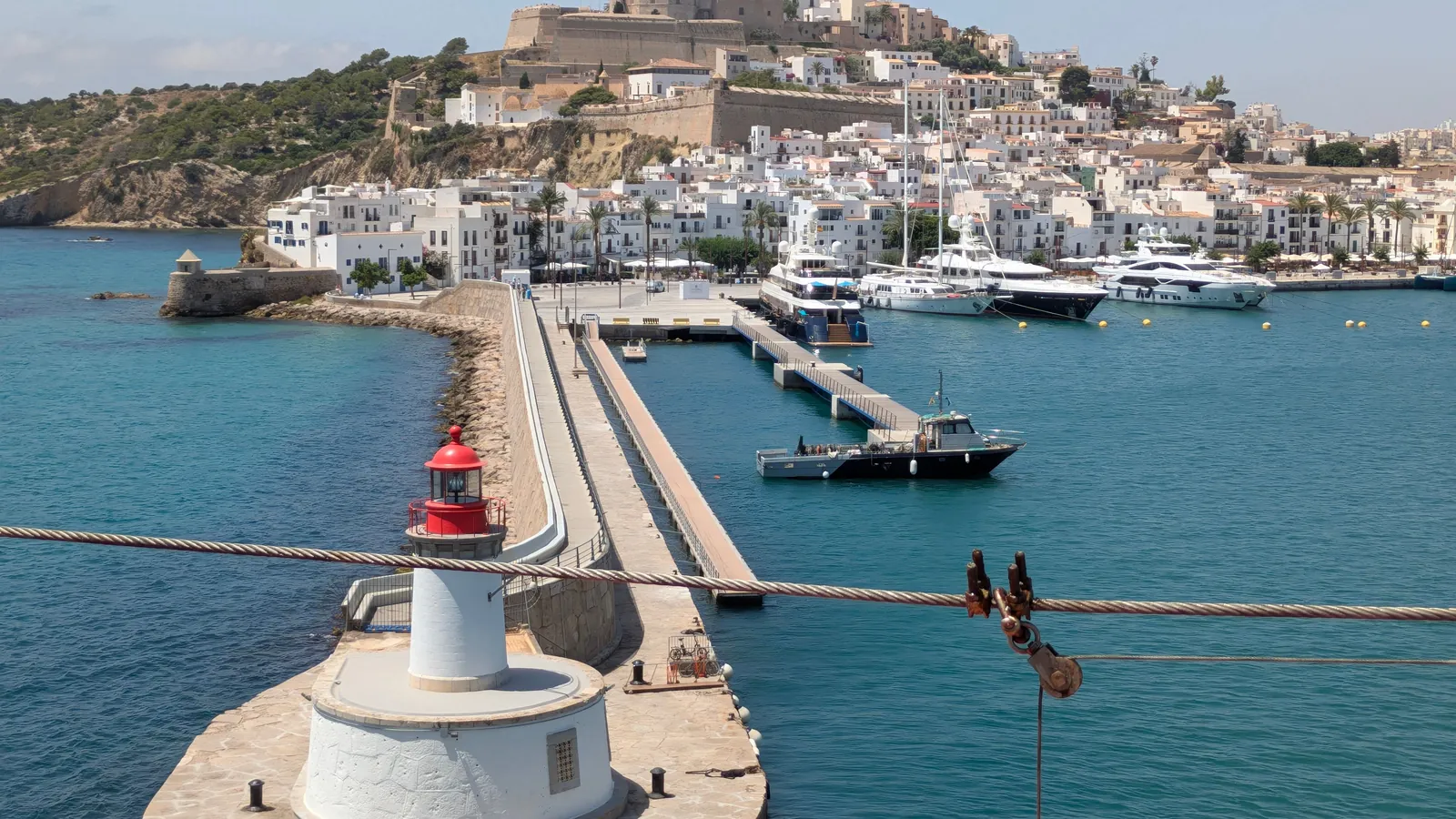
Ibiza is a small, well-connected island, but how you get there shapes the rest of your trip. Flying is the quickest option from almost anywhere in Spain and Europe; taking the boat makes sense if you’re travelling from the Levant or want to bring your car. This guide covers both options, how to get around once you’re on the island of Ibiza, and what changes depending on the time of year.
By plane
Ibiza Airport (IBZ) is in the south of the island, near Sant Jordi and the salt flats, about 7 km from the centre of Ibiza Town. It’s the main gateway: according to Aena, it handled more than 9.1 million passengers and just over 85,000 aircraft movements in 2025, with activity peaking between May and October.
Flights from mainland Spain and the other islands
The domestic routes with the most frequent services are those to Madrid and Barcelona, alongside Valencia, Palma and, in summer, other Spanish cities. Airlines include Iberia (with Iberia Express and Air Nostrum), Vueling and Air Europa. Services are greatly reduced in winter and tend to be concentrated on Madrid, Barcelona, Valencia and Palma, so it’s worth checking well in advance if you’re travelling out of season.
International flights
More than half of the airport’s traffic is international. The largest market is the United Kingdom, followed by Italy, Germany and the Netherlands. For summer 2027, Jet2 has already announced that it will continue flights from its fourteen UK bases and boost services in April, at the start of the season. Ryanair and easyJet round out the connections to much of Europe during the warmer months.
By ferry
The ferry is the natural choice if you live in the Valencian Community or Catalonia, or if you don’t want to leave your car behind. Most regular services dock at the port of Ibiza Town, just a few minutes’ walk from the old town. The main routes are:
- Dénia – Ibiza: the shortest route. Baleària operates it all year, and the crossing takes from around 2 hours on fast boats.
- Valencia – Ibiza: daily departures all year with Baleària, Trasmed or GNV; allow around 5 to 7 hours, depending on the boat.
- Barcelona – Ibiza: around 8 or 9 hours. Many departures are overnight, with a cabin or seat, so you arrive in the morning.
- Palma – Ibiza: useful if you’re island-hopping, with year-round connections and more departures in summer.
Boats to Formentera leave from the same port in Ibiza Town throughout the day; the crossing takes around 30 minutes on fast boats. If you want to see both islands, it’s easy to link them without returning to the mainland.
If you bring your car in summer
Ibiza limits the number of vehicles entering the island during high season. In 2026, the Consell d'Eivissa’s regulation applied from 1 June to 30 September, with a daily cap on cars, and it also covers summer 2027. Vehicles are monitored using automatic number-plate recognition.
If you have a return ticket, the ferry operator handles the permit and you don’t need to do anything else. With a one-way ticket, however, you must arrange your stay through the Consell’s official website, Ibiza Circular. Rental cars on the island have already been cleared by the rental company, so for many travellers it works out better to fly and rent a car there.
Getting around the island
Bus
A new bus network managed by Alsa has been running since 1 April 2026, with up to 65 routes grouped by type: main routes, beach routes, urban routes, night buses and discobús services. During high season, several Aero routes run from the airport: Aero1 to Sant Josep and Sant Antoni, the Aero3 express to Ibiza Town, and Aero5 to ses Figueretes and Playa d'en Bossa. Timetables and stops are available in the Alsa Mobi4U app.
Car, motorbike and taxi
A rental car is the most convenient way to reach northern coves such as Portinatx and Port de Sant Miquel, where buses are less frequent. Distances are short, but in August the car parks near beaches fill up early. A motorbike or scooter can help solve that problem. Taxis have ranks at the airport and in the main towns, although waits can be long on summer nights.
Cycling and walking
Ibiza Town, Santa Eulària and Sant Antoni are easy to explore on foot. There are bike lanes on some stretches and quiet rural roads inland, although the July and August heat makes cycling best for early morning or late afternoon.
When to go and practical tips
The season runs from May to October, peaking in July and August: that’s when there are the most flights and ferries, but also when tickets sell out fastest. May, June and September bring good weather, long days and a quieter island. Many hotels and restaurants close in winter, and services are reduced.
- In summer, book your ferry with a car well in advance, especially in August.
- If you arrive at night, check the timetable for the last bus on your route beforehand.
- Accommodation providers charge the Balearic Islands’ sustainable tourism tax, payable at your destination.
Where to stay depending on how you arrive
If you arrive by boat without a car, Ibiza Town puts you just steps from the port and makes a good base for getting around by bus. Playa d'en Bossa is just a few minutes from the airport, making it practical for short stays. Sant Antoni faces the western sunset, while Santa Eulària des Riu is the quieter, more family-friendly option. We hand-pick accommodation in each of these places, as we explain in about us.
Know how you’re getting there? The next step is deciding where to stay in Ibiza. If you’re taking a trip to the neighbouring island, also see where to stay in Formentera, and if your trip takes in more islands, check out our guides on how to get to the Balearic Islands and where to stay in the Balearic Islands.
Frequently asked questions
The questions travellers most often ask when planning a trip to Ibiza.
Is it better to get to Ibiza by plane or by boat?
It depends on where you’re travelling from and whether you need your car. Flying is quickest from Madrid, Barcelona and most European cities, and the airport is about 7 km from Ibiza Town. Taking the boat makes sense if you live near Dénia, Valencia or Barcelona, or want to bring your vehicle. The crossing from Dénia takes from around 2 hours, while the journey from Barcelona takes more than 8 hours, although overnight departures let you arrive first thing in the morning.
Which ports have ferries to Ibiza?
The main regular routes leave from Dénia, Valencia, Barcelona and Palma, and most arrive at the port of Ibiza Town, beside the old town. Dénia is the shortest connection, taking from around 2 hours on a fast boat, with services all year. The crossing from Valencia takes around 5 to 7 hours, depending on the boat, and from Barcelona around 8 or 9. Services increase in summer, but so does demand, so it’s worth booking in advance, especially if you’re travelling with a car.
Do I need a permit to bring my car to Ibiza?
Yes, during high season. Ibiza limits the number of vehicles entering the island, and in 2026 the measure applied from 1 June to 30 September; the regulation also covers summer 2027. If you buy a return ferry ticket, the ferry operator arranges the permit for you. If you only have a one-way ticket, you must arrange your stay through Ibiza Circular, the Consell d'Eivissa’s official website. Rental cars on the island have already been cleared by the rental company.
How do I get from Ibiza Airport to my hotel?
You can take a bus or taxi, or rent a car. During high season, several Aero routes operate: the Aero3 express goes to the centre of Ibiza Town, Aero1 to Sant Josep and Sant Antoni, and Aero5 to ses Figueretes and Playa d'en Bossa. Timetables are available in the Alsa Mobi4U app. There’s a taxi rank at the terminal, and it’s the most direct option if you arrive late or have a lot of luggage, although queues can form on summer nights. A car is more practical for out-of-the-way areas.
Can you get around Ibiza without a car?
Yes, especially if you’re staying in Ibiza Town, Sant Antoni, Santa Eulària or Playa d'en Bossa. Since 2026, the island has had a revamped bus network with up to 65 routes, including main routes between towns, beach services and night buses in summer. The northern coves and some inland areas are harder to reach without a car, as services are less frequent. One option is to rent a car or motorbike for just a couple of days for those trips.